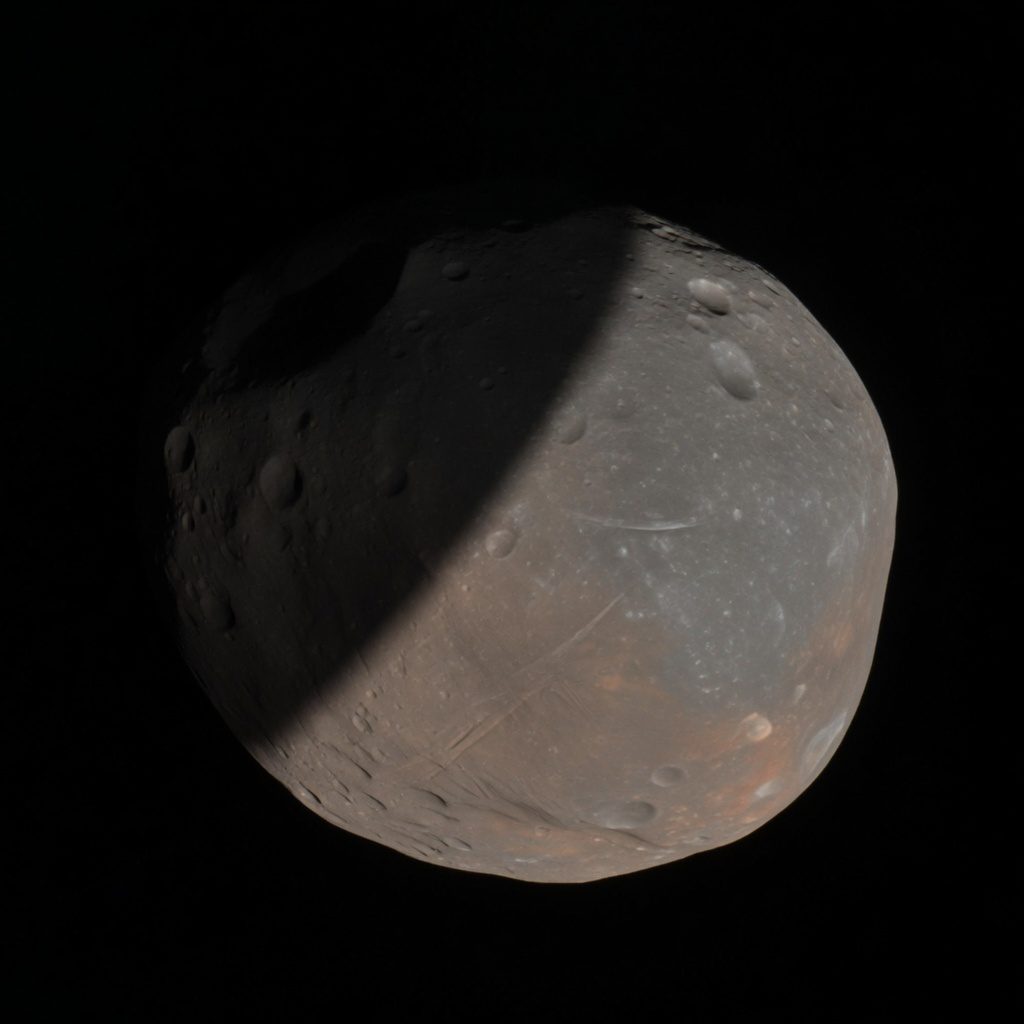
Deimos is the outer and smaller moon of Mars. Hall saw it first, on 12 August 1877, and Phobos five nights later. The fact sheet gives radii of 7.8, 6.0, and 5.1 km, a mass of 2.4 x 10^15 kg, and a semimajor axis of 23,459 km. One orbit takes 1.26244 days, about 30 hours 18 minutes. [1]
Like Phobos, Deimos is tidally locked, dark, and irregular. It is smoother, with fewer of the grooves that mark Phobos, and its orbit is even closer to a circle. The illustration on this page is rounder and brighter than the real moon.
Outside the synchronous line
Deimos orbits beyond the distance where a satellite's period would match the Martian day. Tides therefore push it slowly outward, the same sense in which Earth's Moon recedes. Phobos, inward of that line, is falling. The pair is a tidy demonstration of one rule with two signs.
From Mars, Deimos stays in the sky for a couple of sols at a time and looks only a little larger than Venus does from Earth. It is a bright point, not a disk you could map by eye.
The shared question
Deimos sits in the same origin argument as Phobos: captured asteroid, or debris from a giant impact. Its density, about 1.75 grams per cubic centimeter in the fact sheet, is low for solid rock. JAXA's MMX mission is built to sample Phobos and to fly past Deimos on the way. The planned launch is 20 October 2026. [1]
See also
What links here
References
- NASA Goddard Space Flight Center. Mars Fact Sheet, satellites table. Updated 19 May 2025. https://nssdc.gsfc.nasa.gov/planetary/factsheet/marsfact.html