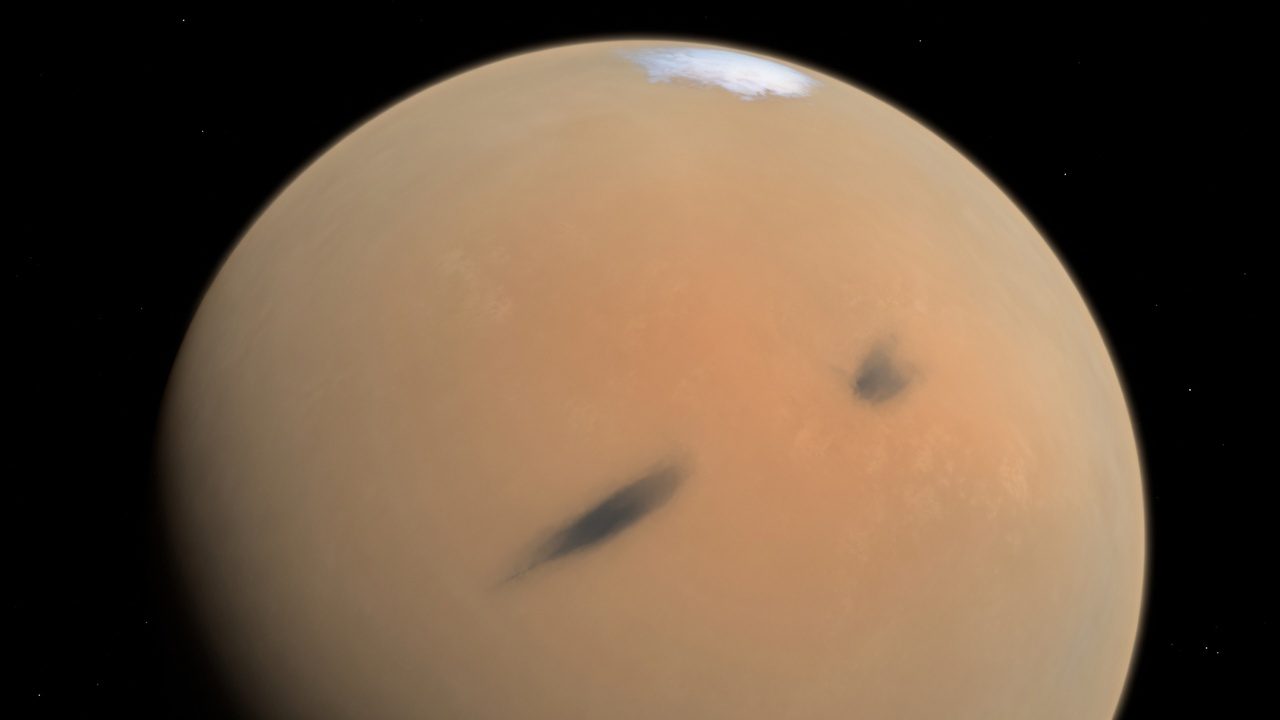
Mars is the fourth planet from the Sun and the second-smallest of the eight planets. A mean radius of 3,389.5 km makes it a little over half as wide as Earth. The ground looks red because fine dust is rich in iron oxide. [1]
It is a desert planet, not a dead sketch. The air is thin and mostly carbon dioxide, the polar caps breathe with the seasons, and the surface still carries dry river valleys, deltas, and lake beds from a wetter past. Two small moons, Phobos and Deimos, orbit close in. No mission has confirmed life. [1] [2]
Orbit and day
The orbit is a stretched ellipse. The semimajor axis is 227.956 million km, or 1.524 AU, and the eccentricity is 0.0935. A sidereal year lasts 686.980 Earth days. NASA's public facts round the year to 687 Earth days, equal to 669.6 sols. [1] [2]
The planet spins once, relative to the stars, in 24 h 37 m 22 s. The mean solar day is longer: 24 h 39 m 35 s. People who drive the rovers call that day a sol. The axis tilts 25.19 degrees, close to Earth's tilt, so Mars has seasons. Because the orbit is eccentric, those seasons are unequal. See Seasons of Mars. [1]
Build of the planet
Mass is 6.4169 x 10^23 kg, about 11 percent of Earth's. Mean density is 3,934 kg/m3, lighter than Earth's, which fits a smaller iron core and a thick rocky mantle. Mean surface gravity is 3.73 m/s^2. Escape speed is 5.03 km/s. [1]
The NASA fact sheet lists a core radius near 1,830 km and notes later results that put the core closer to 1,650-1,675 km. The equatorial radius is 3,396.2 km and the polar radius is 3,376.2 km. From the deepest basin to the tallest volcano, the topographic range is about 30 km. [1]
Surface and air
The face of the planet splits into northern lowlands and southern highlands. Tharsis carries the great shields, including Olympus Mons. Valles Marineris cuts the eastern side of that rise. Hellas Planitia is the deepest wide basin. The full lay of the land is on Geography of Mars. [2]
Surface pressure is 6.36 mbar at the mean radius, less than one percent of Earth's sea-level pressure, and it swings with the seasons as carbon dioxide freezes and thaws. Average temperature is 214 K (-59 C). The mix of gases is tabulated under Atmosphere of Mars. [1]
Water, life, and visitors
Liquid water is not stable on most of the surface today. The rock record says it was once abundant enough to cut valleys and lay down deltas. Water on Mars collects that evidence. Life on Mars is still an open question: habitability is not the same thing as a fossil. [2]
Spacecraft have flown past, orbited, landed, and roved since the 1960s. The working record is Exploration of Mars. Before that, some astronomers mapped canals that were never there. That mistake has its own page, Canals of Mars. [2]
See also
What links here
References
- NASA Goddard Space Flight Center. Mars Fact Sheet. Updated 19 May 2025. https://nssdc.gsfc.nasa.gov/planetary/factsheet/marsfact.html
- NASA Science. Mars: Facts. https://science.nasa.gov/mars/facts/