Mars has water. Most of what remains is ice: in the polar caps, in layered deposits under them, and as shallow ground ice at mid-latitudes. The air holds only a trace of vapor. Stable liquid water is not part of the present surface. [1]
The older story is written in the rocks. Valley networks cross the southern highlands. Deltas enter craters. At Gale and Jezero, rovers have drilled mudstones and conglomerates that formed in standing water. Minerals such as clays and sulfates need water to form. [1]
What the rovers found
Curiosity's early work at Yellowknife Bay, on the floor of Gale, showed a lake that was calm, fresh, and chemically mild enough that microbes could have lived there, if any existed. That is a habitability result, not a detection of life. See Life on Mars.
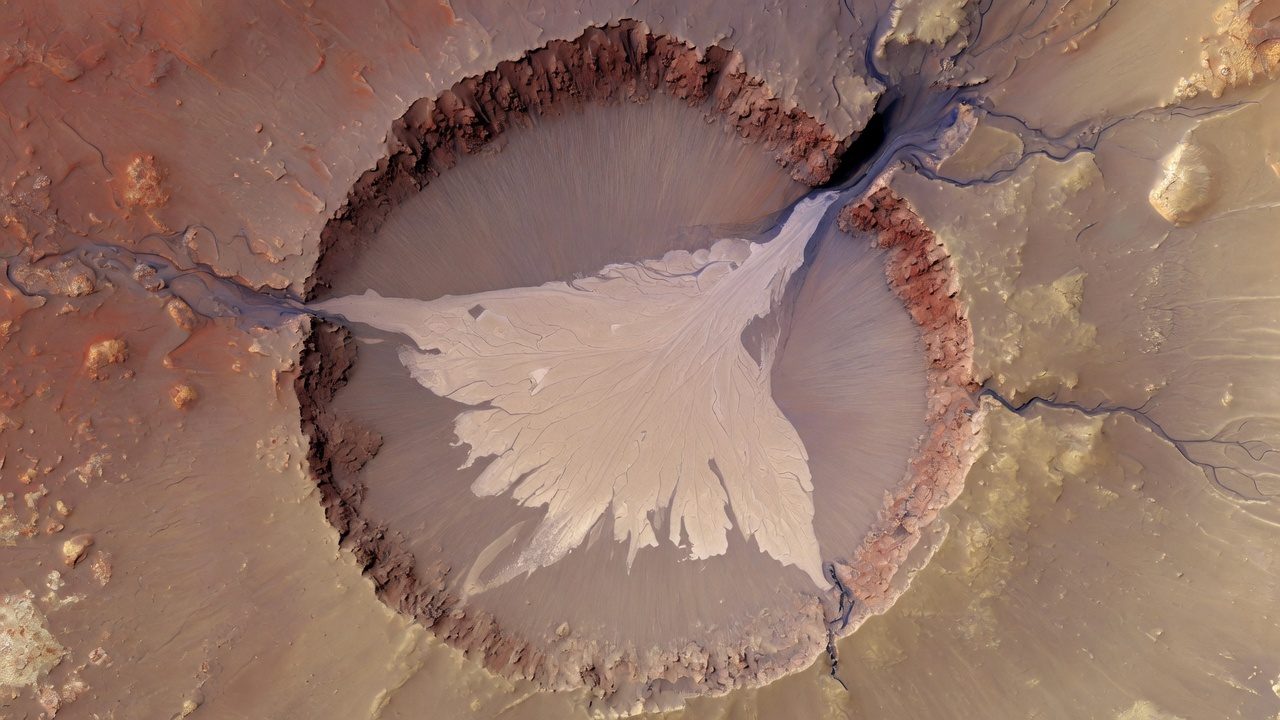
Perseverance landed in Jezero because orbital images showed a delta. The rover has since sampled igneous and sedimentary rocks around that lake system, including the Bright Angel mudstones. The delta picture on this page is an illustration of that kind of deposit, not a photograph of the crater.
Ice now
Phoenix scraped bright ice under the soil of the northern plains in 2008. Radar from orbit maps sheets and glaciers of ice buried at mid-latitudes, often under a dry lag of dust. The residual northern polar cap is water ice. The south keeps water ice too, under a layer of carbon dioxide that lasts through the summer. [1] The evidence classes, and the refusal to turn them into tonnes, are on Subsurface ice. Melting that ice still meets Perchlorates.
Claims to treat carefully
Dark streaks called recurring slope lineae were once offered as possible brine flows. Later work favors dry sand for many of them. Brine droplets can be stable for a short time in special conditions. They are not rivers.
A thicker past atmosphere, discussed on Atmosphere of Mars, is the usual way to explain how lakes lasted long enough to lay down meters of mud. The timing and the climate that kept them liquid are still researched.
See also
What links here
References
- NASA Science. Mars: Facts. Water on Mars. https://science.nasa.gov/mars/facts/