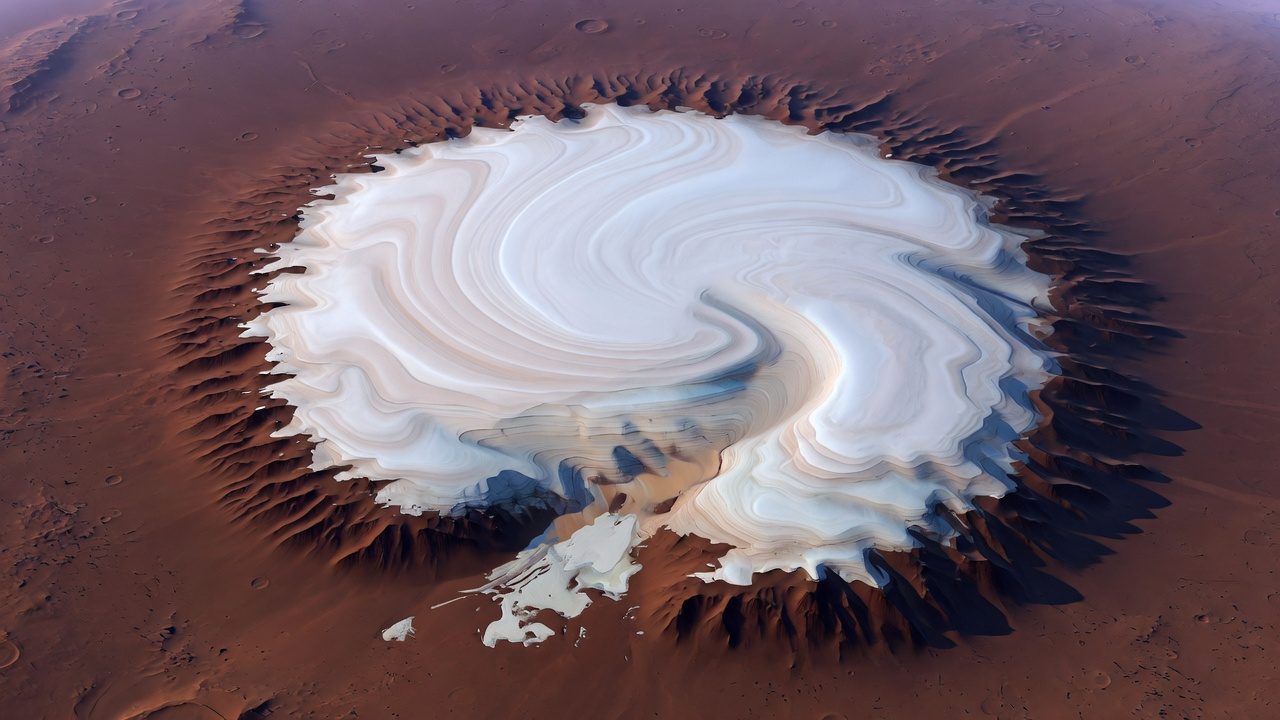
Both poles of Mars grow a seasonal cap of carbon-dioxide frost in winter and lose most of it in summer. The frost is dry ice, not snowpack. As it freezes out of the air, surface pressure across the planet falls. When it sublimes, pressure rises. That pump is part of Atmosphere of Mars. [1]
Under the seasonal frost are residual caps that last through the summer. The northern residual cap is mostly water ice. The southern residual cap keeps a perennial layer of carbon dioxide above water ice. Around both caps, dark dunes collect in a collar.
Layered deposits
Beneath and around the residual ice are the polar layered deposits, stacks of ice and dust a few kilometers thick. The layers are thought to record shifts in orbit, tilt, and dust over millions of years. They are the closest thing Mars has to an ice core, read so far by radar and by the exposed troughs rather than by a drill returned to Earth.
Spiral troughs cut the northern cap. Wind and summer sunlight sculpt them. The illustration here shows the brightness and the dune collar, not a measured map of those troughs.
A reservoir, not an ocean
If the polar water ice melted it would make a shallow sea, not an Earth ocean. It is still the largest known surface reservoir, and together with buried mid-latitude ice it is the present tense of Water on Mars. The seasons that grow and shrink the frost are Seasons of Mars. [1]
See also
What links here
References
- NASA Goddard Space Flight Center. Mars Fact Sheet. Seasonal pressure and composition. Updated 19 May 2025. https://nssdc.gsfc.nasa.gov/planetary/factsheet/marsfact.html