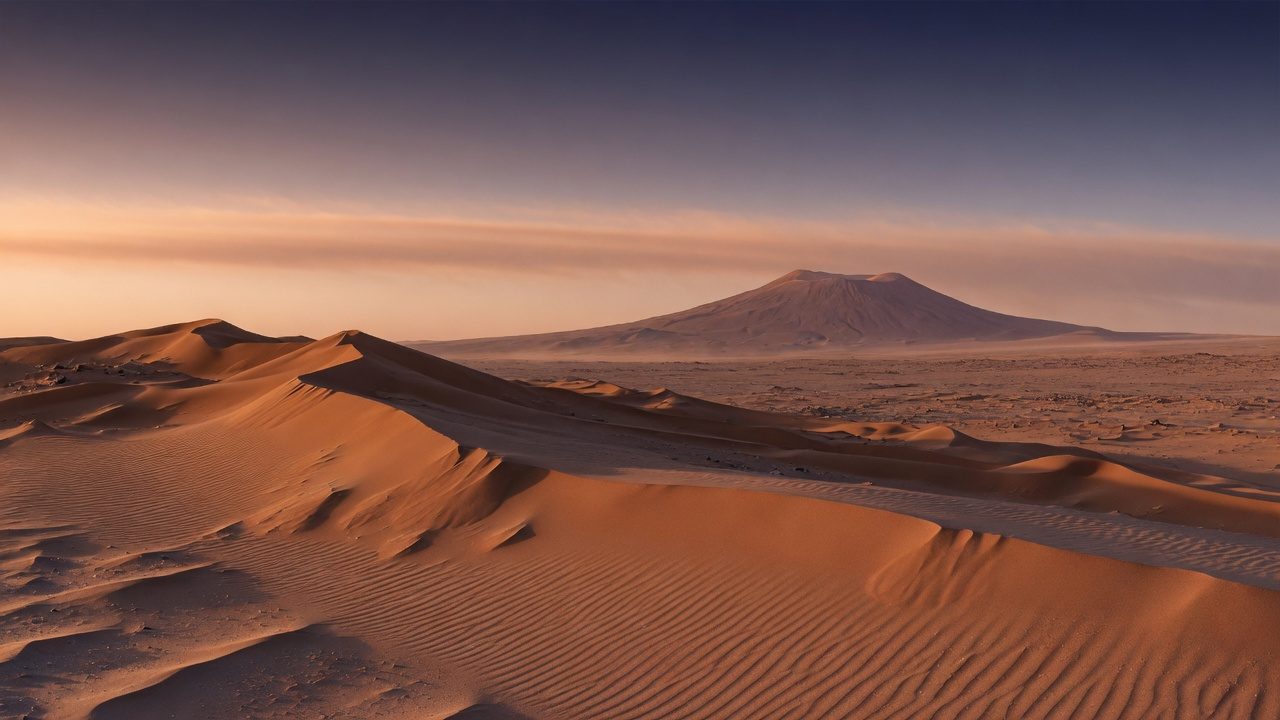
Martian geography is measured from the areoid, a reference surface shaped by gravity and rotation. There is no sea level. Elevations above and below that datum replace it. The full topographic range, deepest basin to highest volcano, is about 30 km. [1]
The oldest division on the globe is the crustal dichotomy. The northern third is a vast lowland. The southern two-thirds are higher, older, and more heavily cratered. Most of the famous names sit on or beside that boundary.
The dichotomy
Northern plains such as Utopia and Acidalia lie several kilometers below the southern highlands. The boundary is a scarp in some places and a jumbled belt of mesas in others. One hypothesis is that a giant impact opened the northern basin early in the planet's history. That idea is not settled.
The lowlands became the landing ground for Viking 2, Phoenix, and China's Zhurong rover. The highlands keep the older valley networks discussed on Water on Mars.
The great landforms
Tharsis is a volcanic bulge thousands of kilometers across. Olympus Mons stands at its northwestern edge. Valles Marineris opens along the eastern flank and runs far enough to cross a continent on Earth. [2]
Hellas Planitia, in the south, is the widest obvious impact basin. Its floor is the deepest regional surface on the planet. The poles carry stacked ice, described on Polar caps of Mars.
Places missions chose
Landing sites are geography with a job. Gale crater holds a mountain of layered rock, so Curiosity could climb a time series. Jezero crater holds a delta, so Perseverance could sample an ancient lake shore. Both choices are arguments about water as much as about maps.
See also
What links here
References
- NASA Goddard Space Flight Center. Mars Fact Sheet. Updated 19 May 2025. https://nssdc.gsfc.nasa.gov/planetary/factsheet/marsfact.html
- NASA Science. Mars: Facts. https://science.nasa.gov/mars/facts/