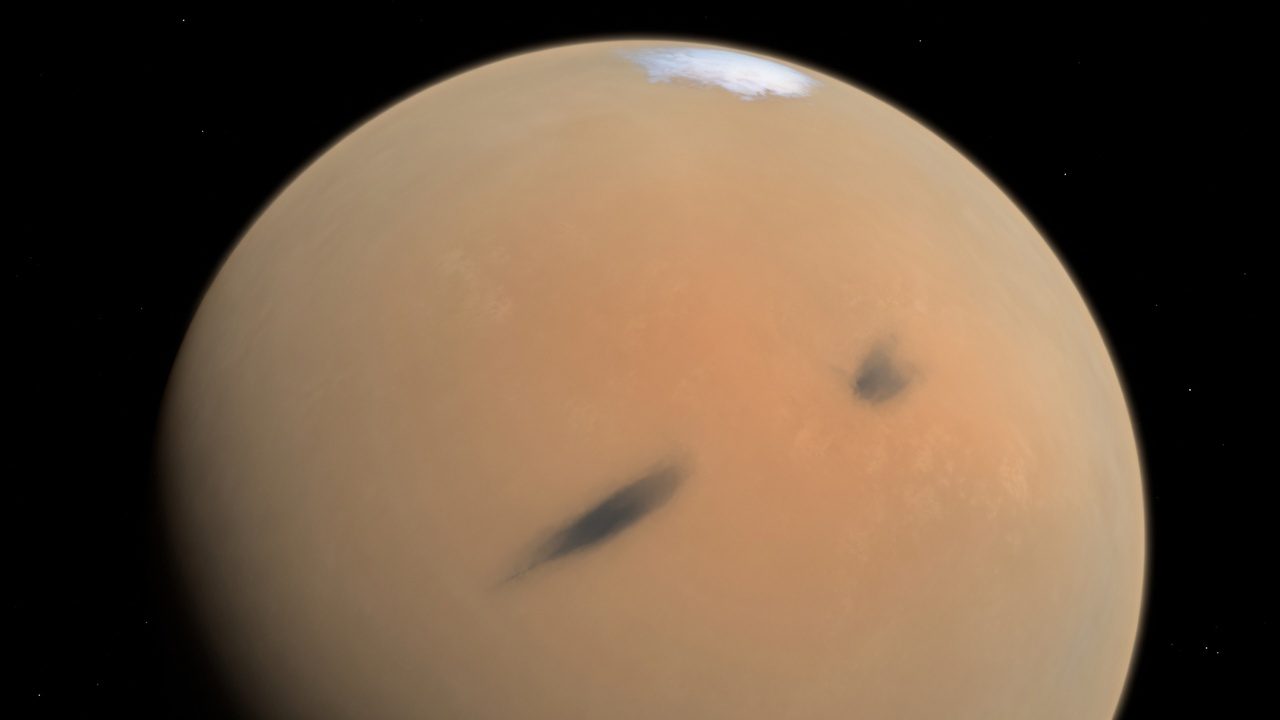
Dust is always in the air of Mars. Storms lift much more of it. They range from dust devils a few hundred meters wide, to regional clouds, to planet-encircling events that hide the surface for weeks. The disk on this page is an illustration of that last kind. [1]
Southern spring and summer, near perihelion, are the storm season. Heating is stronger then. See Seasons of Mars. The thin air means even a fast wind carries little force, but it carries abrasive dust, and the dust can block the Sun.
Two storms that changed missions
Mariner 9 reached Mars in November 1971 during a planet-encircling storm. The first pictures showed almost no surface. When the dust fell, the orbiter mapped Olympus Mons and Valles Marineris for the first time.
In 2018 another global storm darkened the sky over Opportunity. The solar-powered rover sent its last contact on 10 June 2018. NASA declared the mission complete on 13 February 2019. Curiosity, powered by a nuclear generator in the same years, kept working through the dim sky at Gale.
What a storm does
Lifted dust warms the middle atmosphere and cools the surface in shade. Pressure and winds shift. At the Viking landers, storm winds were about 17 to 30 meters per second. That is a strong breeze in Earth terms, and a serious cleaning and coating problem for solar panels. [1]
Dust devils, the small cousins, sometimes wipe panels clean. A mission can be saved by one and ended by the other. The physics lives in Atmosphere of Mars.
See also
What links here
References
- NASA Goddard Space Flight Center. Mars Fact Sheet. Wind speeds. Updated 19 May 2025. https://nssdc.gsfc.nasa.gov/planetary/factsheet/marsfact.html