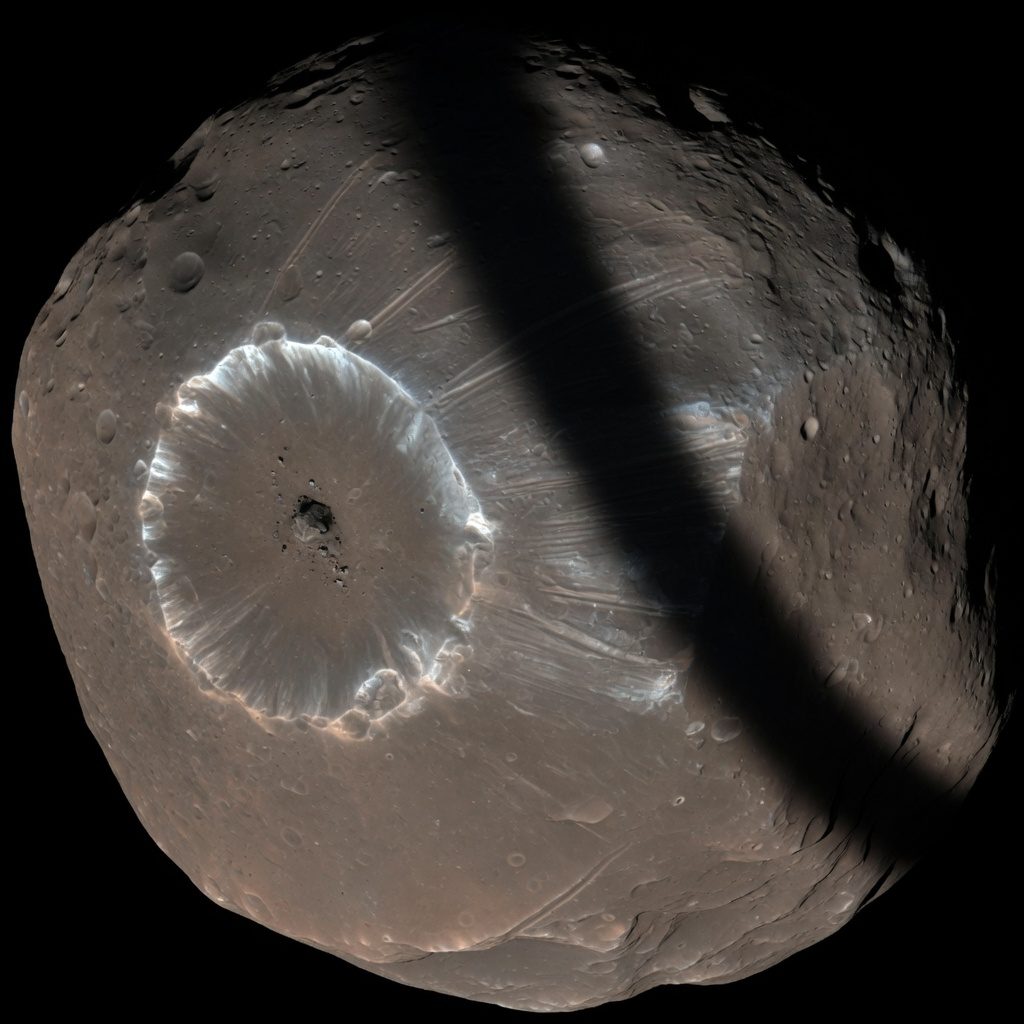
Phobos is the inner and larger moon of Mars. It is a dark, potato-shaped body, not a round world. The NASA fact sheet gives radii of 13.0, 11.4, and 9.1 km along its three axes, a mass of 10.6 x 10^15 kg, and a semimajor axis of 9,378 km. It orbits in 0.31891 days, about 7 hours 39 minutes, and it keeps the same face toward Mars. [1]
Asaph Hall found it on 17 August 1877, five nights after he found Deimos. The names are the attendants of Ares: fear and dread. Hall's wife, Angeline Stickney, proposed them. The largest crater on Phobos is named Stickney.
An orbit that is failing
Phobos orbits inside the synchronous distance, so tidal forces drag it inward. The decay is on the order of a couple of meters per century. On a timescale of tens of millions of years it will break up or hit Mars. Deimos, outside that line, is slowly moving the other way.
From the surface of Mars, Phobos rises in the west and sets in the east, and it crosses the sky in a few hours. It is too small to eclipse the Sun the way Earth's Moon does. It can still cast a partial shadow.
Where it came from
Two ideas remain open. One is that Phobos and Deimos are captured asteroids. Their dark surfaces and low densities, about 1.9 grams per cubic centimeter for Phobos, look asteroidal, and the density says the interior is porous or icy-rock rather than solid metal. The other idea is that they formed from debris after a large impact on Mars. A capture has trouble explaining the round, equatorial orbits. An impact has trouble explaining every spectral detail. A returned sample is the practical way to decide. [1]
MMX
JAXA's Martian Moons eXploration mission, MMX, is planned to launch on 20 October 2026, land on Phobos, and return a sample to Earth around 2031. NASA is contributing the MEGANE gamma-ray and neutron spectrometer. This sheet is dated 26 September 2026, so the launch is still ahead of the page. [2]
See also
What links here
References
- NASA Goddard Space Flight Center. Mars Fact Sheet, satellites table. Updated 19 May 2025. https://nssdc.gsfc.nasa.gov/planetary/factsheet/marsfact.html
- NASA Science. MMX, Martian Moons eXploration. Proposed launch 20 October 2026. https://science.nasa.gov/mission/mmx/