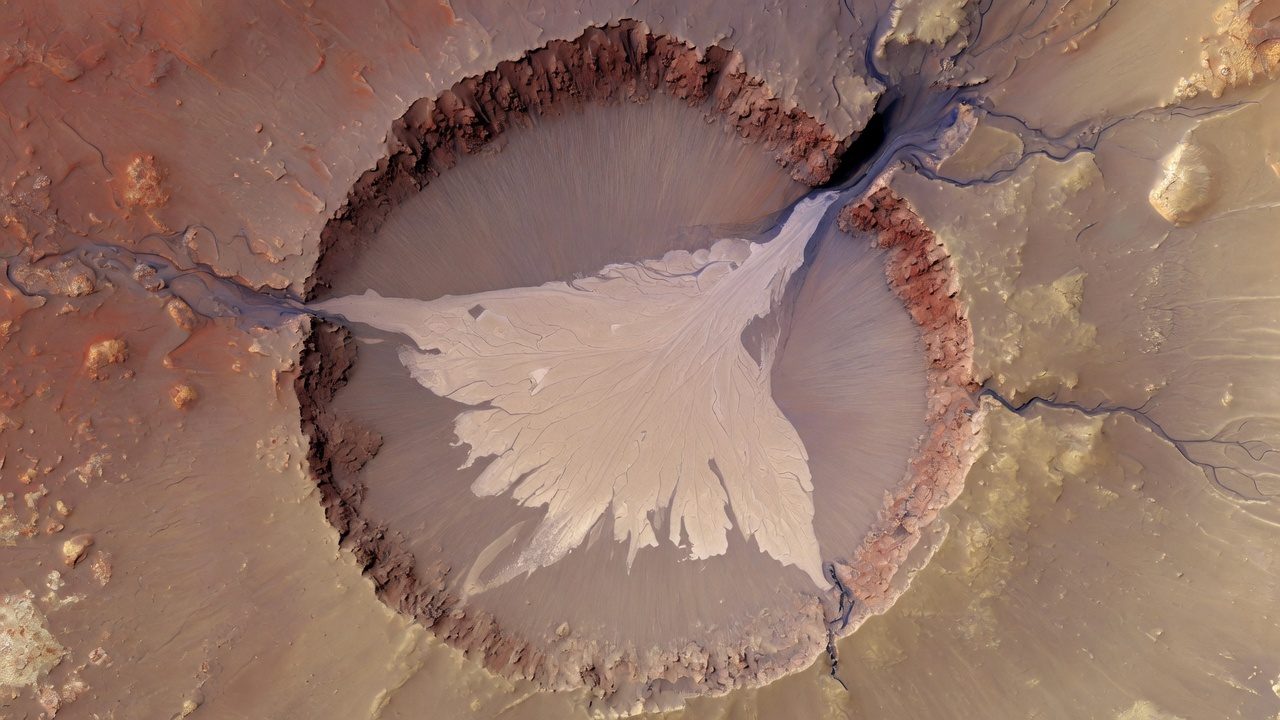
Jezero is a crater about 45 km across on the western edge of Isidis. A channel breached the rim and built a delta into a lake. That delta is why NASA sent Perseverance. The rover landed on 18 February 2021. The picture here is an illustration of a crater-floor delta, not a photograph of Jezero.
The lake is long gone. What remains is the sediment, the carbonate-bearing margin, and a cache of sealed tubes. One of those samples, Sapphire Canyon, is the subject of Life on Mars.
The lake and the delta
Orbital images show an inlet valley, a fan of sediment, and an outlet. That pattern is a lake with a shoreline, not a stain of dust. The western fan is the one Perseverance was built to read. Clays and carbonates around the margin record water altering the rock. The wider case is on Water on Mars.
Neretva Vallis is the inlet that fed the fan. In 2024 the rover studied mudstones there, in a spot called Bright Angel, and drilled the rock nicknamed Cheyava Falls.
The cache
Perseverance drills a core about the size of a piece of chalk and seals it in a tube. At Three Forks, on the crater floor, it left a backup depot of 10 tubes between December 2022 and January 2023, in case the rover itself could not deliver samples later. Other tubes stay aboard.
Bringing the cache to Earth was the Mars Sample Return campaign. As reported by Science on 5 August 2026, the spending agreement does not support that existing program. The tubes were still on Mars. See Exploration of Mars. [1]
Engineering screen
This sheet does not store a landing elevation for Jezero, so Site dossiers does not compute a pressure here. A JPL graph caption says the crater sits about 2,600 m below the reference level. That figure is a crater-scale remark, not the rover's wheels, and it is not used as an elevation. [2] Soil oxidant is Perchlorates. Ice evidence for the landing area is none cited. See Subsurface ice.
See also
What links here
References
- Science. NASA's Mars Sample Return mission is dead. 5 August 2026. https://www.science.org/content/article/nasa-s-mars-sample-return-mission-dead
- NASA Jet Propulsion Laboratory. Jezero crater elevation graph, 12 December 2024. About 2,600 m below the reference level. Not a landing elevation. https://www.jpl.nasa.gov/images/pia26476-jezero-crater-elevation-graph/