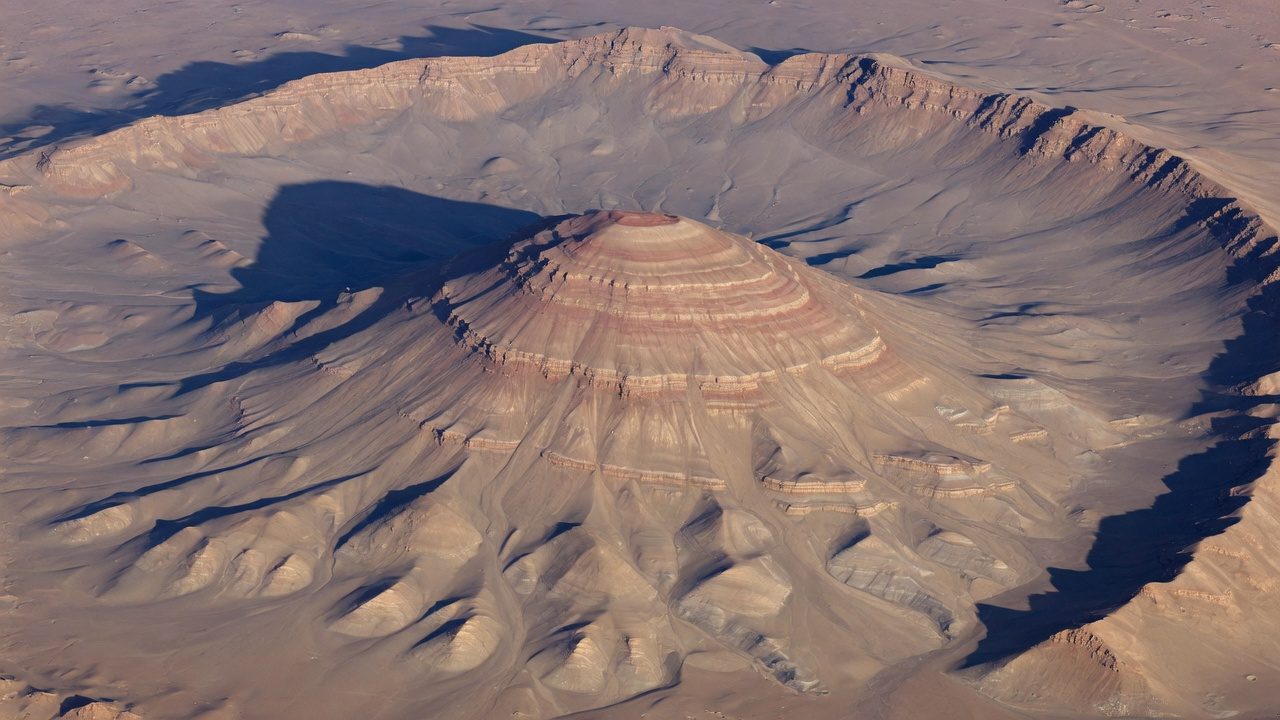
Gale is a crater about 154 km across, just south of the equator. In its middle stands Aeolis Mons, usually called Mount Sharp, a layered mountain about 5 km high. NASA sent Curiosity because those layers are a time series a rover can drive through. The landing was 6 August 2012, at a site named Bradbury Landing. [1]
The rover was still at work in September 2026, more than 5,000 sols after landing. On 26 August 2026 it marked 1 km of elevation gain from the floor. The illustration shows the idea of a layered mound, not a photograph of Gale. [1] [2]
What the layers did
Near the floor, at Yellowknife Bay, Curiosity found mudstone from a lake that was habitable billions of years ago: liquid water, the needed chemical elements, and an energy source. Later layers higher on the mountain record drier conditions, with sulfates and a long record of changing lakes and dunes. Habitability is not life. That distinction is the point of Life on Mars.
The mountain is a mound of sediment that filled the crater and was later eroded, not a volcano. Comparing it with Olympus Mons is a category error the picture might invite. The rocks here are a book of water.
Still climbing
A nuclear generator lets Curiosity work through dust storms that end solar missions. The wheels are damaged, some instruments have aged, and the team has changed how it drives. NASA's August 2026 note still shows the rover climbing Mount Sharp and looking back at the floor. [1]
The sister crater in the current program is Jezero, where Perseverance is caching samples rather than climbing a single mountain.
Engineering screen
Bradbury Landing, the 6 August 2012 touchdown, is 4.5895 S, 137.4417 E, at -4501 m relative to the areoid. [3] Site dossiers runs the pressure screen for that point. The screen is not a weather forecast, and this crater is not a selected city. Slopes, rocks, and bearing strength are not assessed here. The soil oxidant is Perchlorates.
See also
What links here
References
- NASA Science. Curiosity Reaches 1-Kilometer Elevation Gain. 26 August 2026. https://science.nasa.gov/mars/curiosity-reaches-1-kilometer-elevation-gain/
- NASA Science. Curiosity Postcard Celebrates Rover's 5,000th Day on Mars. 16 September 2026. https://science.nasa.gov/photojournal/curiosity-postcard-celebrates-rovers-5000th-day-on-mars/
- Vasavada et al. Overview of the Mars Science Laboratory mission: Bradbury Landing to Yellowknife Bay and beyond. JGR Planets, 2014. Touchdown at 4.5895 S, 137.4417 E, -4501 m. https://doi.org/10.1002/2014JE004622